

Following COP30 in Belém, the decision to develop the Just Transition Mechanism created a significant opportunity to advance implementation support for countries navigating socio-economic transformations in climate action. Alongside it, the COP30 Presidency’s transitioning away from fossil fuels (TAFF) Roadmap – an initiative led by a coalition of the willing – elevated the urgency of ensuring that climate action is not only ambitious, but also planned in a just, orderly, and equitable manner. This signaled that credible transition must go beyond energy and emissions to include the institutional, social, and economic transformation that accompany it.
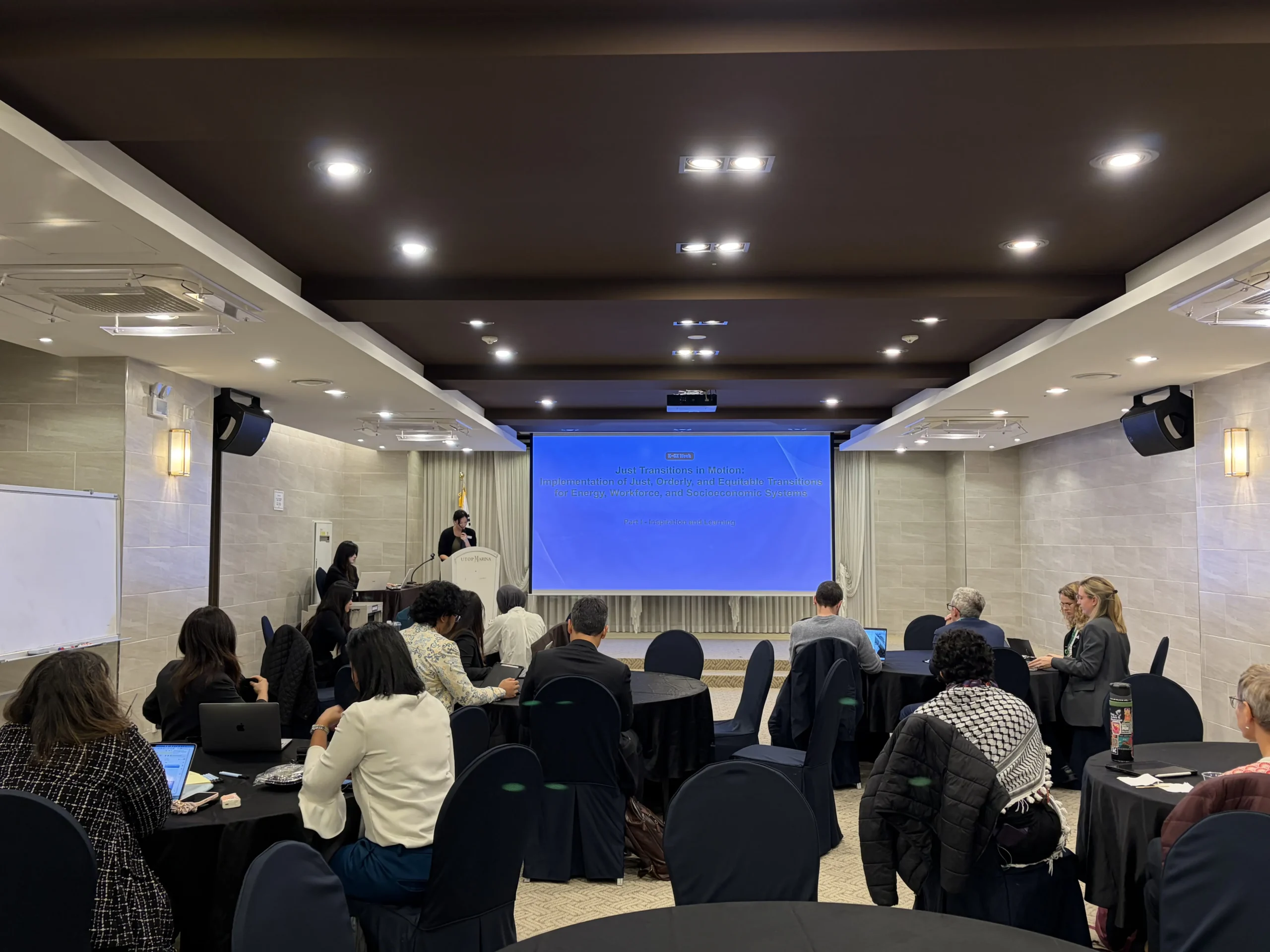
In this context, the workshop, “Just Transitions in Motion: Implementation of Just, Orderly and Equitable Transitions for Energy, Workforce and Socioeconomic Systems,” held by Solutions for Our Climate (SFOC), LACLIMA, and Indonesia Research Institute for Decarbonization (IRID), alongside the UNFCCC Climate Week in Yeosu, South Korea, brought together participants from various countries and backgrounds for a timely discussion on TAFF and broader Just Transition momentum. Discussions revealed that while the concept of Just Transition is widely accepted, its implementation continues to lag. Bridging this gap requires moving high-level commitments to practical and grounded approaches that lead to long-term transition planning.
Understanding Just Transition
Generally, just transition means managing the shift to a low-carbon economy in a way that is fair and inclusive, distributing the costs and benefits of transformation and ensuring that no one is negatively impacted by the transition–particularly workers, communities, and regions most affected by decarbonization. The Just Transition approach provides a holistic way of planning these transitions, focusing on the ways in which changes in how we produce or consume goods and services and how we manage natural resources could affect wider social, economic and environmental goals.
Encouragingly, many countries have begun embedding just transition principles into their Nationally Determined Contributions (NDCs). In addition, a significant step forward was the COP30 agreement to develop an international Just Transition Mechanism under the UNFCCC – a dedicated space to strengthen international cooperation, share knowledge and ensure equitable and inclusive just transitions. As we move toward implementation, a key milestone is expected in June 2026 during the Bonn Climate Sessions, when negotiators will shape the rules for how it will work in practice, ahead of a formal decision at COP31. These upcoming moments represent a real opportunity to elevate the issue.
Therefore, the multilateral system, especially the UNFCCC framework, must continue to center the just transition and ensure that the voices of those most impacted are reflected in global discussions. Pre-COP preparations should lay on the groundwork combining formal and informal moments for negotiators and non-party stakeholders to interact and build an inclusive Just Transition Mechanism.
Just Transition at the Subnational Level
Many countries have now implemented just transition principles at the subnational level. Indonesia, for instance, has a de-dieselization program in East Nusa Tenggara which illustrates four key dimensions of just transition challenges.
First, human capital remains a major challenge. While renewable energy education is expanding, there is a mismatch between training and job availability. Graduates struggle to enter the workforce due to limited industry absorption, and reskilling efforts often fail to provide livelihoods comparable to those in fossil fuel sectors. Even where vocational schools and universities offer renewable energy programs, industry readiness to absorb graduates remains very low — and the jobs created rarely match the wages previously earned in coal or other fossil fuel industries.
Second, access to technology remains unequal. High costs and geographic barriers hinder deployment, while local capabilities for maintenance and operation are still insufficient.
Third, financing gaps persist at every stage of the transition. At the community level, reliance on electricity tariffs often fails to cover long-term maintenance costs, which can create sustainability risks. Even though it needs to be scaled up, public finance alone is insufficient, and financial institutions such as regional development banks have not yet been fully mobilized to fill this gap.
Fourth, fragmented policy and institutional misalignment undermine progress. Overlapping regulations and weak coordination between national and subnational level slow implementation, highlighting the need for more integrated governance. Tensions between national policy and subnational realities create particular barriers for renewable energy. These challenges illustrate that just transition requires sustained and long-term commitment that persists across changing governments and administrations.
Deep Diving into the Finance Gap
Workshop discussions saw finance emerge as the most critical barrier, not because of the lack of funds; but rather due to considerations of accessibility and equity. Many Global South countries face high costs of capital and are constrained by loan-based financing mechanisms that risk increasing debt burdens.
Additionally, financial flows are largely centralized, limiting access for subnational actors. Without direct access to funding, locally led transition efforts remain difficult to implement and scale. The proposed solutions that emerged from the workshop include carbon pricing mechanisms, redirecting revenues from instruments such as Cross Border Adjustment Mechanism (CBAM), and exploring debt relief and non-debt-creating finance. However, aligning finance with local needs remains an unresolved challenge.
Exploring Other Gaps
Implementation barriers also extend into political and institutional domains. One of the major gaps is the absence of robust tracking mechanisms. Without clear systems to measure progress, it is challenging to ensure accountability and incentivize action.
A further gap is the need for shared governance frameworks. Workshop participants highlighted the importance of reframing just transition narratives to engage businesses and economic stakeholders — moving away from preaching to the already-converted and toward economically-framed arguments that speak to industry interests. Without stronger alignment between climate goals and economic priorities, progress will remain slow. Critically, if the same business actors that built the fossil fuel economy drive the clean energy transition, there is a real risk that it will reproduce rather than redress existing inequalities — making regulatory oversight and fair tax redistribution essential.
What can be learned is that transitions happen locally, even when policy and finance are centralized. Cities and regions can be acting as hubs of innovation, piloting approaches to workforce transition and renewable energy deployment. However, these efforts face significant barriers. Thus, strengthening coordination between national and subnational levels, as well as improving direct access to finance, may support more effective implementation at the local level.
Practical Mechanisms to International Frameworks
The implementation of just transition remains complex and context-specific. Addressing the challenges requires more than new frameworks—it demands structural changes in finance, governance, and stakeholder engagement. It also requires a shift in perspective that just transition should not be seen as a fixed outcome, but as an ongoing process that balances economic, social, and environmental priorities.
Just transition offers a critical opportunity to support this implementation process through knowledge exchange, technical assistance, and improved coordination. However, its success will depend on its ability to translate global commitments into tangible impacts at the community level.

