

At the 29th Conference of the Parties (COP29) in Baku, Azerbaijan, Parties agreed on the decision to set a new climate finance target to be mobilized at least USD 300 billion per year by 2035 for developing countries, with developed countries taking the lead[1]. A broader ambition was also agreed, which is to mobilize USD 1.3 trillion annually from public and private sources to support low greenhouse gas emissions and climate-resilient development. The USD 1.3 trillion target, in accordance with paragraph 7 of the decision, calls for all actors to collectively mobilize finance. The “Baku to Belém Roadmap to 1.3T” (the Roadmap) was then mandated to be launched under the guidance of the 6th Conference of the Parties serving as the Meeting of the Parties to the Paris Agreement (CMA6) and the CMA7 Presidencies, in conjunction with COP30 which will be held in Belém, Brazil. Clarifying the roles of “all actors” to scale up climate finance for developing countries, as stated in the New Collective Quantified Goal (NCQG) decision, is crucial. In addition to that, removing barriers in accessing funds will be the key to securing an equitable and effective finance deal for developing countries.
Brazil, as the CMA7 Presidency, also formed the COP30 Circle of Finance Ministers to provide inputs to develop the Roadmap. The CMA Presidency has indicated that the Roadmap must consist of five strategic priorities: the reform of Multilateral Development Banks (MDBs), expanding concessional finance, creating country platforms and strengthening domestic capacity, promoting innovative finance, as well as strengthening regulatory frameworks for climate finance.
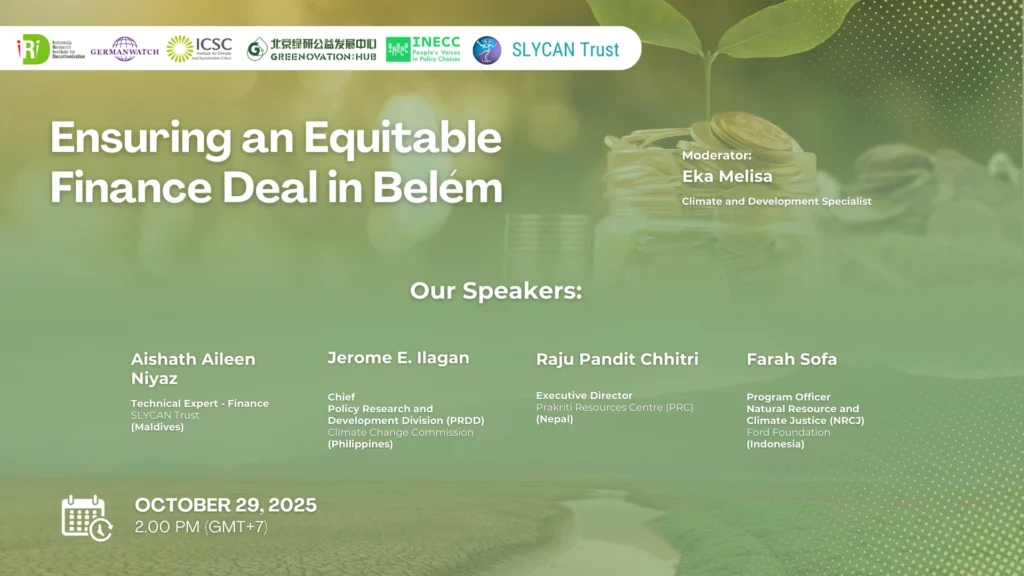
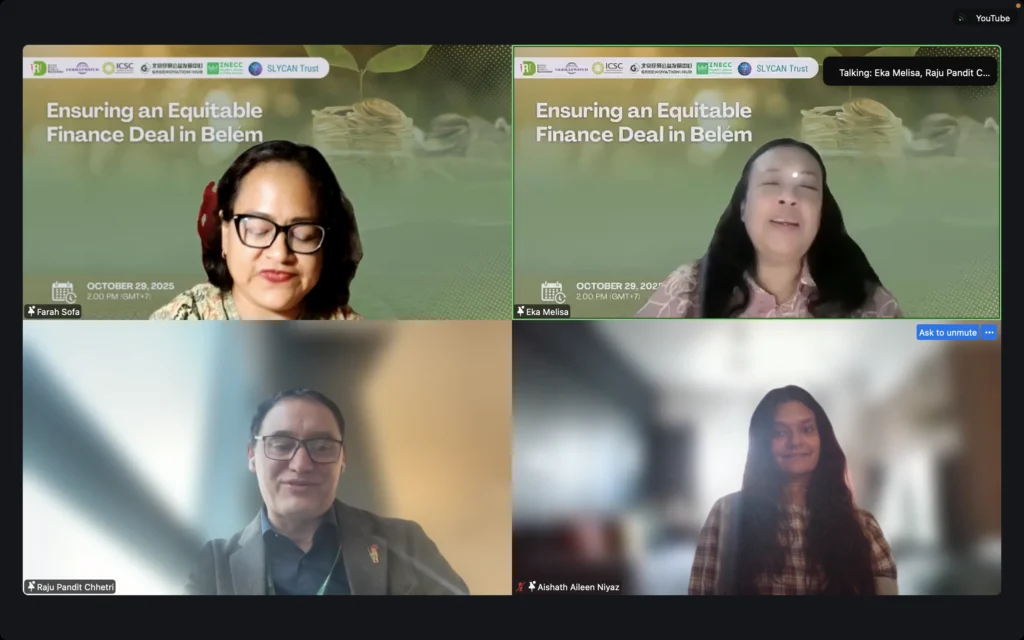
Indonesia Research Institute for Decarbonization (IRID) together with Germanwatch, Institute for Climate and Sustainable Cities, LAYA Resource Center, INECC, Greenovation Hub, and SLYCAN Trust held a knowledge-sharing session on October 29th, 2025, to learn and discuss what would be the most suitable finance deal that is equitable and sufficient to address the needs and priorities of the developing countries.
Key Issues on Climate Finance Negotiation at COP30
At COP30/CMP20/CMA7, climate finance issue is likely to feature prominently across various agenda items, including the Baku to Belém Roadmap. The Roadmap was agreed at CMA6 to operationalize the NCQG into actionable steps. The Roadmap was expected to ensure that the mobilization of USD 1.3 trillion target will be achieved, emphasizing it to be equitable, accessible, grant-based, concessional, and non-debt-creating climate finance[2].
While working for its operationalization, achieving the NCQG’s USD 1.3 trillion climate finance target is undermined by persistent structural barriers. The current climate finance model shows continued preference for mitigation funding, with comparatively lower allocations for adaptation and loss-and-damage. Many developing countries also note that a continued reliance on loan-based instruments introduces risks to long-term fiscal stability, especially when grant availability remains limited. Additionally, complicated requirements and long, indirect funding processes make it difficult for people and communities to access climate finance directly. Addressing these gaps is essential to ensure the NCQG truly delivers equitable and accessible climate finance for those who need it most.
However, in the provisional agenda for COP30/CMA7, NCQG does not included as a formal negotiation agenda. In Belém, the Roadmap would be presented at the CMA6 and CMA7 Presidencies Joint High Level Event on the B2BR without any formal negotiation process on the Roadmap itself.
For developing countries, the Roadmap is not the only priority; there are several other priorities on climate finance agenda, including the tripling of adaptation finance by 2030, the launching of FRLD’s first call for funding proposals, and addressing access barriers faced by Least Developed Countries (LDCs) and Small Island Developing States (SIDS), particularly regarding the need for capacity, data, and simplified procedures. Other issues such as, structural issues including MDBs reform, sovereign debt challenges, subsidies, and global tax reforms, are also expected to shape the negotiations. With the Long-Term Finance (LTF) discussion to be concluded in 2027, there is a possibility that future finance discussions will be consolidated under the CMA, making the NCQG and the Roadmap to be the central pillars of climate finance governance.
The Roles of Various Actors in Scaling Up Climate Finance
Achieving the NCQG target of USD 1.3 trillion per year requires a coordinated mobilization effort across public and private finance actors. Under the Paris Agreement, developed countries are expected to continue carrying the obligation to provide and taking the lead to mobilize climate finance. In this context, the quality of climate finance mobilization is as critical as its scale. MDBs and UNFCCC operating funds – including the GCF, the Adaptation Fund, and the FRLD – are expected to increase financial flows, uphold integrity to avoid double counting, and strengthen equity parameters so that funding reaches climate-vulnerable groups, such as indigenous peoples, local communities, and women.
Developing countries could also contribute to the climate finance landscape through South-South Cooperation. It is an emerging modality where countries of the Global South share technical knowledge, align regulatory learning, and cooperate on adaptation and resilience financing channels to reduce procedural complexity in access to climate funds, to other Global South countries. This cooperation framework is expected to facilitate institutional learning and resource exchange, strengthening developing country capacity while promoting solutions that are more aligned to national and regional resilience priorities.
Other than that, philanthropic organizations have emerged as powerful catalytic actors. Their ability to take early-stage risks, provide flexible capitals, and to support grassroots solutions, helps to unlock larger investments from MDBs and private financing. Furthermore, philanthropic funding also advances climate equity by directly supporting the priorities of indigenous and local communities, as well as enabling experimentation with new financing models.

