


Indonesia’s Golden Vision 2045 outlines ambitious climate and development targets, including a 32% reduction in greenhouse gases (GHG) emission by 2030 to achieve Net Zero Emissions (NZE) by 2060. However, achieving these goals requires vast climate financing. The Indonesian Ministry of National Development Planning (BAPPENAS) estimated a sustainable development financing gap of around USD 1.7 trillion, while the Indonesian Ministry of Energy and Mineral Resources (KESDM) projected an annual cost of USD 28 billion for the early retirement of Coal-Fired Power Plants (CFPPs). The JETP Secretariat estimated the need for energy transition at USD 97.3 billion for the electricity sector by 2030, excluding financial needs for just transition interventions.
Indonesia’s climate ambition is strongly reflected in the Financial Omnibus Law, which acts as a driver for accelerating sustainable transition within the financial sector. The law supports the transition by mandating the integration of sustainability across financial institutions and embedding just transition principles to safeguard jobs, support Small and Medium-sized Enterprises (SMEs), and ensure the inclusivity of vulnerable communities. This aligns climate finance with social equity to drive inclusive economic transformation. The Place-Based Just Transitions report produced by the Asia Investor Group on Climate Change (AIGCC) provides recommendations for Indonesia’s policy baseline to embedding social justice within climate financing. It identifies enablers and gaps for people-centred, locally relevant, and financially viable transition pathways, emphasizing the need to redirect investment from fossil fuels toward community-centred economic diversification. pathways.
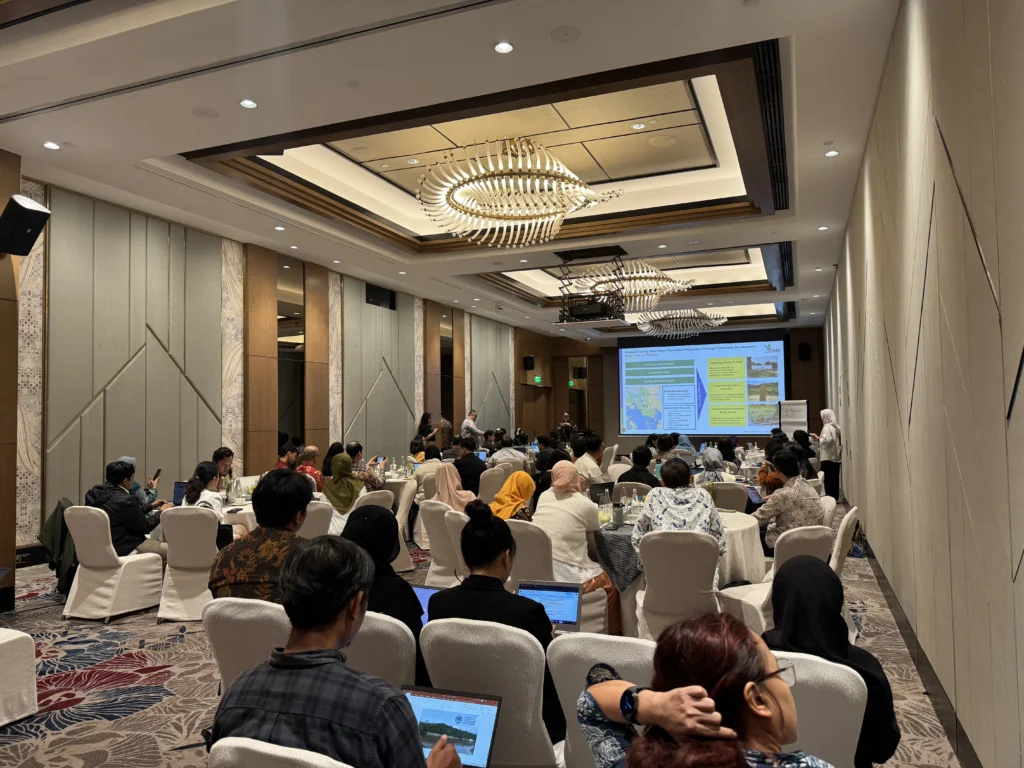
The Indonesian Ministry of Finance, in collaboration with Indonesia Research Institute for Decarbonization (IRID) and AIGCC, convened a multi-stakeholder roundtable, on October 9th 2025, to understand how the financial sector in Indonesia can support Indonesia’s low greenhouse gas emission and resilient development strategies that are implemented in a justly manner.

Policy Landscape and Financing Potential for Just Transition in Indonesia
Indonesia has submitted its Nationally Determined Contribution (NDC) which reflects Indonesia’s commitment to reduce greenhouse gas emissions, including its needs and priorities to adapt with the impact of climate change. However, according to the 2018-2023 Climate Budget Tagging (CBT) Report by the Ministry of Finance, Indonesia’s public funding could cover only 16.4% of the financial required to meet the Nationally Determined Contributions (NDC) targets, leaving 83.6% to be filled by other sources, such as private and international finance. It is, therefore, the role of financial sector in Indonesia is crucial to close the finance gap.
Indonesia’s government recognizes the need to transition from carbon-intensive to low-carbon development, beyond Indonesia’s NDC. To accommodate the needs, Indonesia’s government embedded sustainability through the Financial Omnibus Law, which mandates the integration of Environmental, Social, and Governance (ESG) aspects into business practices and investment strategies. The Law also mandates the establishment of sustainable finance taxonomies as well as the set up of a Sustainable Finance Committee to align investments with Asta Cita and Vision 2045 goals.
In addition to that, to address the finance gap, Indonesia is expanding their blended finance mechanisms, green bonds, transition finance, and the Energy Transition Mechanisms (ETM) to retire CFPPs while scaling up renewable energy. Indonesia’s financial institutions, such as PT Sarana Multi Infrastruktur (PT SMI), are also pioneering in just transition-aligned financing through green loans, investment grants, and socio-economic frameworks to safeguard communities during energy transitions. At the same time, validation and verification bodies, such as PT Sucofindo, play a crucial governance role by ensuring integrity in carbon markets.
Place-Based Just Transition Approach
A place-based just transition emphasizes that the transition toward a low-carbon economy must be inclusive, equitable, and adapted to local conditions. Instead of applying uniform policies, this approach tailors transition strategies that reflect the social, cultural, and economic conditions of specific regions. This approach recognizes that workers, communities, and industries experience the consequences of transition differently and therefore require different responses.
In Indonesia, where coal remains a source of revenue and employment, place-based approach can be used to identify locally appropriate pathways for clean energy and economic diversification. It also enables a stronger community engagement, ensuring that vulnerable groups affected by the transition, such as informal workers, rural populations, and low-income households, are supported through social protection and reskilling programs.
Achieving just transition requires financing models that blend public, private, and concessional capital to balance risks and maximize social benefits. Grants and concessional funds should be used to complement market-based investments in green infrastructure, while investors apply social governance standards that safeguard workers, households, and local communities. By applying this, it ensures climate finance to contribute to both emission reduction and social well-being through collaboration among governments, investors, and communities. By embedding local needs in policy and finance, a place-based just transition approach will help Indonesia to achieve its climate ambition of achieving the NZE by 2060, and at the same time ensuring social equity.
Place-Based Implementation in the FOLU Sector
A just climate transition also applies in other sectors beyond energy. In the forestry and other land uses (FOLU) sector, a just climate transition ensures that climate actions, such as forest conservation, protect vulnerable communities and enhance social and economic benefits, while minimizing negative impacts. Considering that many livelihoods depend on natural resources, weak designed policies to support climate transition, such as national government’s projects at the subnational level could affect local communities’ rights through unfair land acquisition processes. This can further lead to loss of access to resources, loss of jobs without viable alternatives, and disruption of indigenous peoples and local communities.
Thus, embedding safeguards in climate transition projects are essential to ensure fairness, inclusivity, and socially responsible. Several key principles that needs to be implemented along with climate actions include: procedural justice through community-led participation and transparency; wage equality and decent work by ensuring fair pay, safe working conditions, and upskilling and reskilling opportunities; as well as gender equity by ensuring that women have equal land rights, access to credit, and leadership roles in project governance.
Public and private sector surely play crucial roles in contributing funding, technology, and ESG-aligned business models to drive equitable and sustainable transitions. However, effective implementation also requires collaboration with another sector, such as philanthropies. Through Public-Private-Philanthropic Partnerships (4Ps), philanthropies can act as catalytic finance, connecting communities with private stakeholders and taking on flexible, higher-risk efforts to enable wider partnerships in achieving just climate transitions.

