

According to the World Meteorological Organization (WMO) report in 2024, Asia was warming nearly twice as fast as the global average, triggering climate risks across the region. With the increasing greenhouse gas (GHG) emissions, the temperature signals the need for ambitious mitigation measures to reduce the GHG concentration at the atmosphere. One of the measures to reduce the GHG emissions is by accelerating the energy transition, including in Asia,reducing the dependence from carbon-intensive energy systems.
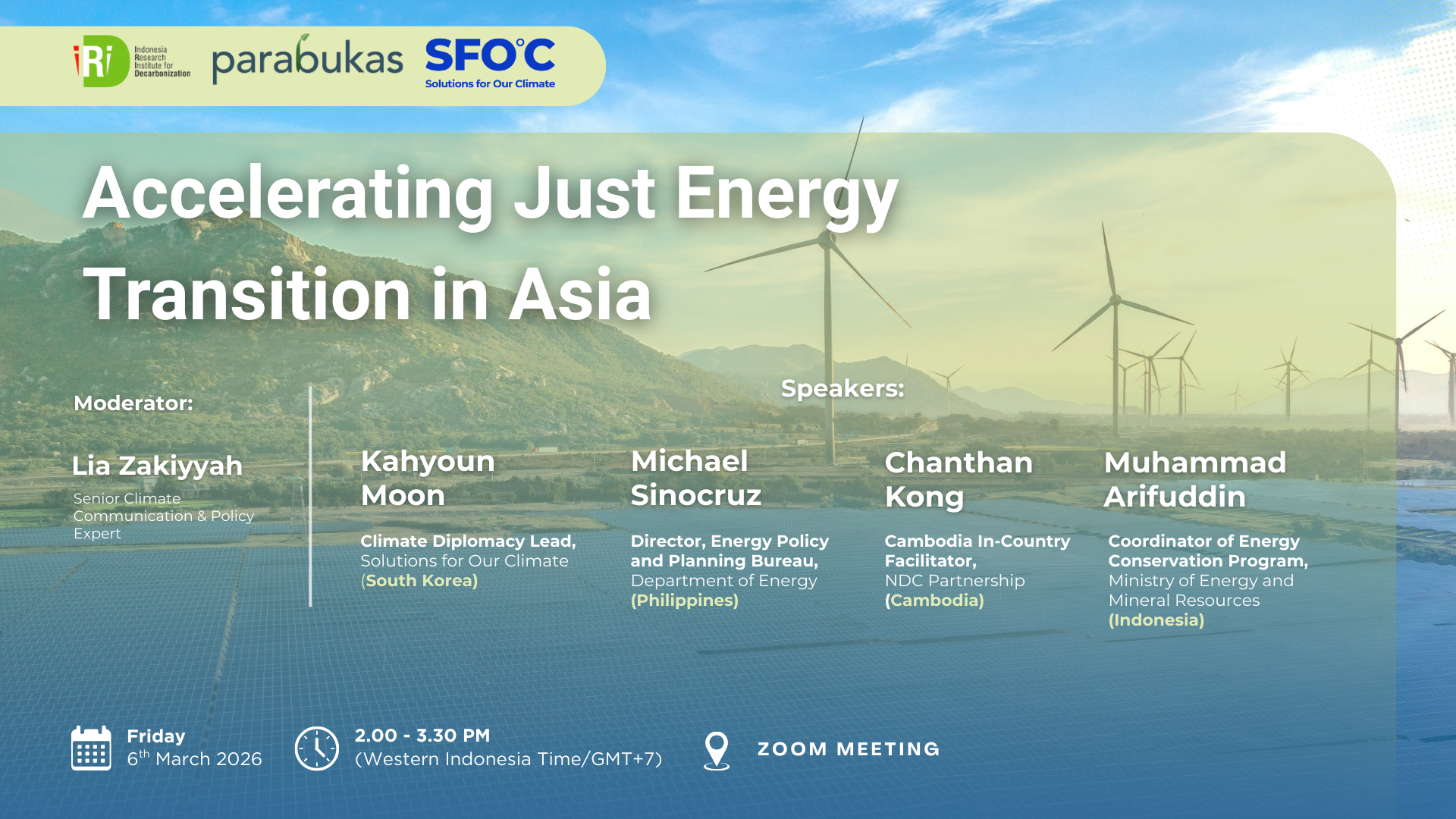
Recognizing the diverse circumstances of Asian countries, it is important to understand their readiness for just energy transition, from technical, financial, and socio-economic perspectives. On 6 March 2026, Indonesia Research Institute for Decarbonization (IRID), Solutions for Our Climate (SFOC), and Parabukas convened the first webinar series entitled “Accelerating Just Energy Transition in Asia” to gain learnings and understanding, to identify Asia’s readiness for just energy transition.
South Korea’s Coal Transition Pathway
During COP30 in Belém, South Korea became the second country in Asia to join the Powering Past Coal Alliance (PPCA)[1]. South Korea has officially committed to phasing out 40 out of their 61 coal power plants by 2040 and developing a concrete pathway for the remaining 21 plants by this year. This shift was driven by both international and domestic factors. At the international level, it was started in 2021 when South Korea, Japan and China, announced the moratorium on overseas coal financing. At the domestic level, the was driven by a strong South Korea’s subnational leadership from Chungnam province, which hosts nearly half of the country’s coal plants and declared a climate emergency with a carbon neutrality target by 2045.
However, South Korea faces significant challenges in implementing energy transition, including a major financing imbalance, complex permitting and grid adaptation requirements, and rapidly rising electricity demand. Currently, South Korea is preparing its Basic Energy Plan 2026–2040 to address energy transition barriers and ensure that the country must balance energy security with climate ambition. South Korea’s experience demonstrates that a just energy transition is not only about phasing out coal, but also about ensuring energy security, economic stability, and social acceptance through broader regional discussion and implementation.
The Philippines’ Role in Just Energy Transition
The Philippines’ energy system is heavily reliant on fossil fuels. In 2024, around 60% of the country’s primary energy supply came from fossil fuels. While energy consumption in the Philippines is largely driven by the transport and household sectors, the power generation is also coal-heavy, contributed about 60% in 2024, yet decreasing to 56% in 2025 (Department of Energy Philippines, 2026).
Nevertheless, the Philippines has set its energy transition goals through renewable energy and energy efficiencyt measures. The Philippines has set its renewable energy target for power generation to be 35% by 2030 and 50% by 2040 (and beyond), whilst the energy efficiency goals of 10% savings in electricity and oil consumption[2]. These goals require several key enablers, including balancing energy transition with economic growth, technology innovation, strong regulatory and political commitment, financial investment, and human capital development.
Currently, the Philippines is developing its National Just Transition Framework that emphasizes people-centered principles in climate actions. As the 2026 Chair of the Association of Southeast Asian Nations (ASEAN), the Philippines promotes the vision of “Shaping the Energy Future Together through Partnership, Innovation, and Resilience”, which aligns with ASEAN Plan of Action for Energy Cooperation (APAEC) (2026-2030). The APAEC emphasizes just and inclusive transition, balancing energy security, affordability, and sustainability.
Cambodia’s Just Transition Roadmap
Cambodia is still at the early stage in developing a fossil fuel phase-out roadmap, yet it has actively engaged in policy discussions and preparatory processes toward a just energy transition. Cambodia submitted its latest Nationally Determined Contribution (NDC) in August 2025, committing to achieve 72–80% of clean energy in the total energy mix and expanding clean energy in transportation, manufacturing, construction, agriculture, and waste management.
In recent years, Cambodia has contributed in several activities, including regional multistakeholder workshops as a preparation for a fossil fuel phase-out; participating in senior-level dialogues and international Fossil Fuel Treaty initiatives; and expressing strong support for joining the Fossil Fuel Treaty process. Cambodia plans to conduct technical assessments of the fossil fuel transition roadmap, with the support of the Fossil Fuel Treaty Secretariat, in the near future. Cambodia also actively pursues forest protection and reforestation initiatives, utilizes carbon credits to fund conservation, and engages in circular-economy cooperation projects with Japan to reduce plastic waste.
Indonesia’s Readiness for Just Energy Transition
Indonesia frames the energy transition through energy security and national resilience, which can be measured through energy availability, accessibility, affordability, and accceptability. Recalling its Enhanced NDC, Indonesia has set an emission reduction target in the energy sector at 358 million tons of CO2e through renewable energy, energy efficiency, clean power generation, low-carbon fuel, and post-mining reclamation. By 2025, Indonesia’s new and renewable energy mix has reached 15,57% (8,29% from electricity and 7.46% from non-electricity). Indonesia’s renewable power plants have contributed to more than 15 GW of the national electricity system, dominated by hydropower and bioenergy sources (MEMR, 2026). Furthermore, Indonesia’s energy transition plan is also reflected in the Electricity Supply Business Plan (RUPTL) 2025-2034, which aims to add more than 42 GW of renewable energy and 10 GW of energy storage. To support that, Indonesia is currently strengthening the transmission and grid flexibility to integrate variable renewables, expanding smart grids and energy storage, and exploring early retirement of coal-fired power plants (CFPP) under specific conditions. In remote islands, the transition from diesel-based power generation to solar PV and battery storage systems has emerged as a key strategy, alongside efforts to promote a people-centered energy transition through initiatives such as the Energy Patriot Program. Indonesia’s experience highlights that renewable energy expansion requires a strong system readiness and infrastructure, long-term policy certainty, and a transition that remains people centered.
[1] Powering Past Coal Alliance (PPCA) adalah koalisi pemerintah nasional dan subnasional, bisnis, dan organisasi yang bekerja untuk memajukan transisi dari pembangkit listrik tenaga batu bara ke energi bersih.
[2] PHILIPPINE ENERGY PLAN (PEP) 2023-2050, Department of Energy Philippines, 2025.

